Why Your Current Architecture Cannot Support AI at Scale
AI works in development and stalls in production. The reason is almost always architectural. Here is how legacy data pipelines, integration rigidity, API latency, and governance gaps block AI at scale and what to fix first.
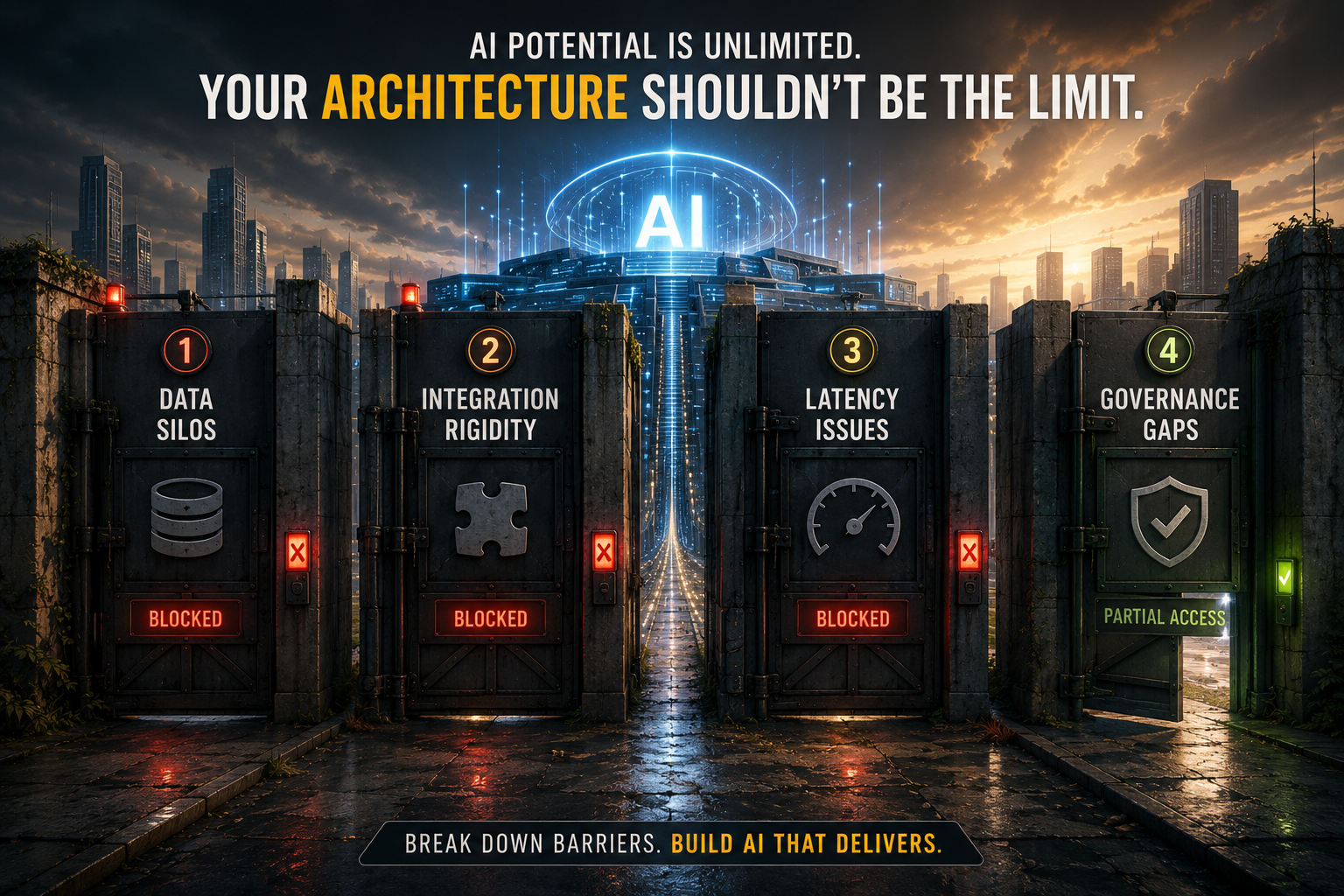
Most enterprise AI initiatives do not fail because the model is wrong. They fail because the architecture underneath it was never built to support what AI actually needs to work.
Nearly two-thirds of enterprises worldwide have experimented with AI agents. Fewer than 10 percent have scaled them to deliver tangible value. The gap between experimentation and production scale is not a model selection problem. According to McKinsey's April 2026 research, eight in ten companies cite data limitations as the primary roadblock to scaling agentic AI. The model is ready. The architecture is not.
The pattern that produces this outcome is consistent across industries and organization sizes. A conversational layer gets added to a legacy workflow. A predictive model gets deployed on top of incomplete data. A generative tool gets embedded into systems that were never designed for real-time intelligence. These experiments produce early excitement, and then they stall. Not because the AI stopped working, but because the architectural constraints that were always there became impossible to ignore once AI started pulling on them.
This article breaks down the specific mechanisms through which legacy architecture prevents AI from reaching production scale, what the architectural requirements of modern AI workloads actually are, and what the modernization path looks like for organizations that are currently stuck between an AI strategy and an infrastructure that cannot support it.
Marka's team works with enterprises across healthcare, manufacturing, finance, and public administration on exactly this problem. If your organization has working AI in development that is not moving into production, or pilots that are not converting into organizational capability, the starting point is an architecture review. Reach the team at marka-development.com/contacts.
The Four Structural Failures That Block AI at Scale
Legacy architecture fails AI through four specific mechanisms. These are not configuration issues that can be resolved through patching or tooling additions. They are structural, and understanding them precisely is the prerequisite for making the right modernization decisions.
Data inaccessibility. AI systems, and particularly agentic AI systems that need to act across enterprise workflows, require unified, contextualized data that spans multiple domains and is available in real time. Most legacy enterprise architectures store data in siloed systems built for transactional workloads, with inconsistent schemas, duplicated records across departments, and no unified data layer. Poor data categorization alone increases AI implementation costs by up to 40 percent according to Gartner's 2025 research. When mission-critical data is trapped in an isolated mainframe or distributed across a dozen systems with incompatible formats, the AI model is architecturally disconnected from the actual state of the business. It produces outputs that are only as good as the stale or fragmented data it can reach.
Integration rigidity. Legacy systems without APIs, or with aging API layers that were designed for synchronous point-to-point integrations, turn every AI use case into a bespoke engineering project. Each new AI capability must solve the same infrastructure problems from scratch because there is no composable integration layer that AI agents can work through. Research from the European Journal of Computer Science and Information Technology found that legacy systems average 52 custom API endpoints required per AI integration, representing approximately 3,200 development hours per use case. At that cost, most AI use cases simply do not get built.
API latency incompatibility. Legacy systems with multiple synchronous hops and tightly coupled services operate at average API response latency of around 3.1 seconds. Modern AI workloads, particularly agentic pipelines where multiple AI calls execute in sequence, require consistent sub-400 millisecond response times. The gap matters more than it might appear. In an agentic pipeline where an agent makes four sequential API calls, every extra second of latency per call adds four seconds to the end-to-end response time before the agent has produced a single output. At legacy system latency, agentic workflows become operationally unusable for anything customer-facing or time-sensitive.
Governance gaps. Legacy security models were designed for well-defined system boundaries and static access controls. AI systems operate across dynamic data flows, external model providers, and autonomous execution paths that legacy governance frameworks cannot instrument or control. As organizations move toward agentic AI, the risk profile changes fundamentally: the concern is no longer only about AI systems saying the wrong thing, but about AI systems doing the wrong thing, taking unintended actions, misusing tools, or executing outside appropriate guardrails. Legacy architecture has no native controls for this class of risk, and retrofitting them without a governance-aware modernization program produces compliance exposure.
Why Batch Processing Is the Specific Bottleneck Most Organizations Underestimate
The batch processing architecture that underlies most legacy enterprise systems is the single most underestimated AI blocker in production environments. It is worth examining specifically because it is the failure mode that most organizations do not identify until they are already trying to deploy AI and watching it produce degraded outputs.
Traditional ETL pipelines run on fixed schedules. Data is extracted, transformed, and loaded at intervals, whether hourly, daily, or weekly, depending on the system. This approach worked for transactional reporting and batch analytics where the currency of data was measured in hours or days. AI workloads, particularly those involving real-time decision-making, fraud detection, personalized customer experiences, or generative responses, require low-latency access to continuously updated data.
When AI models depend on stale inputs, output quality degrades in a specific way. In generative AI scenarios, this manifests as hallucinations, outdated responses, and incomplete contextual understanding, exactly the class of AI failure that erodes user trust fastest. In predictive scenarios, it manifests as models that were accurate in the training environment but perform poorly in production because the data they see at inference time does not match the freshness of the data they were trained on.
The practical consequence is that deploying an AI model on top of a batch-processing architecture does not produce a slow AI system. It produces an unreliable one, and unreliable AI in a production enterprise context carries a different risk profile than slow AI. Unreliable AI gets turned off. Slow AI gets optimized.
85 percent of enterprises report that legacy systems actively block their AI adoption, and a major component of that blockage is the batch-to-real-time gap that organizations consistently underestimate when scoping AI projects. The organizations that discover this constraint mid-deployment are in a fundamentally worse position than the ones that surface it during architecture review, because the remediation timeline imposed by a stalled production deployment is always shorter and more expensive than a planned modernization program.
What AI Workloads Actually Require from Architecture
Understanding the architectural requirements of modern AI workloads is the starting point for any honest modernization assessment. The requirements are different from what enterprise architecture was designed to provide, and the differences are specific.
Real-time data access with sub-second latency. AI inference workloads, particularly for customer-facing applications, require data access at latency tolerances that legacy databases and ETL pipelines were not designed to meet. Voice assistant applications require under 200 milliseconds time-to-first-token. Consumer-facing chatbots require under 500 milliseconds. Even internal enterprise AI tools, where the tolerance is higher, require consistent sub-second data access to remain usable in production workflows. Legacy batch pipelines that deliver data in hours or minutes create an architectural incompatibility that no model optimization can compensate for.
Elastic compute for unpredictable workloads. Model inference and training create compute demand that is fundamentally unpredictable in ways that traditional enterprise workload planning was not designed to handle. A marketing campaign that triggers a surge in AI-powered personalization requests, an agentic workflow that fans out into parallel subtasks, a batch retraining job that competes for compute with a live customer-facing inference workload: these are all scenarios where elastic compute capability determines whether the system performs or fails. Legacy on-premise infrastructure cannot scale elastically to meet these demands cost-effectively. Cloud platforms that provide dynamic compute scaling, including GPU allocation for inference-heavy workloads, are a prerequisite for production AI at scale, not an optimization.
Composable, API-first integration architecture. AI agents need to execute tasks across the enterprise, not just retrieve data from it. An AI agent that can answer a customer question needs to be able to query the CRM, check inventory in the ERP, and create a follow-up task in the workflow system, all within a single interaction. This requires an integration architecture that exposes enterprise functions as composable, callable services through well-defined APIs. Monolithic systems where business logic is embedded in application layers and not exposed through APIs cannot support this execution model. The agent has nowhere to reach.
End-to-end data lineage and observability. AI systems in regulated industries are increasingly required to explain their outputs, demonstrate that the data used to produce them was handled within defined governance controls, and provide audit trails that satisfy compliance requirements. Legacy data platforms rarely provide end-to-end visibility into data lineage, transformations, and quality metrics. This creates a structural compliance gap for organizations subject to NIS2, DORA, the EU AI Act, or sector-specific regulations like HIPAA and financial services reporting requirements. You cannot explain an AI output if you cannot trace the data that produced it.
The Incremental Path That Most Enterprises Are Actually Taking
Replacing every legacy system before deploying AI is neither practical nor necessary. The organizations that are converting AI investment into production value in 2026 are taking an incremental path that sequences modernization correctly rather than a big-bang replacement that carries years of risk.
McKinsey's March 2026 research on enterprise architecture for the agentic era frames this clearly. The incremental path sees agentic AI not as a wholesale substitute for existing systems but as a layer of augmentation that extends what already works. Just as the adoption of microservices enabled agile software delivery without dismantling the enterprise core, the first wave of agentic AI sits atop legacy systems to extend their capabilities through a well-designed orchestration layer, while the underlying architecture is progressively modernized.
The practical sequencing that works is the following.
First, establish a real-time data layer. This does not require replacing the legacy system. It requires building a streaming data pipeline alongside it that captures change events and makes them available to AI workloads at low latency. Tools like Azure Event Hubs and Azure Stream Analytics, integrated with existing legacy systems through change data capture, can bridge the batch-to-real-time gap without replacing the source system. This single step unblocks the largest class of AI production failures.
Second, create a composable API layer over existing systems. Legacy systems that do not expose APIs can be wrapped with an API gateway that exposes their functionality as callable services. This is the Strangler Fig pattern applied at the integration layer. New AI workflows call the API layer, which calls the legacy system, while the legacy system itself is progressively replaced component by component. The AI capability goes live while the modernization program runs in parallel.
Third, instrument governance at the orchestration layer. Rather than trying to retrofit AI governance controls into individual legacy systems, implement them at the layer that orchestrates AI agent interactions. Access controls, audit logging, rate limiting, and output validation can be enforced at the orchestration layer consistently, regardless of what the underlying systems can support natively. This closes the governance gap for regulated environments without requiring changes to the legacy core.
Fourth, sequence compute modernization to follow data and integration readiness. Moving to elastic cloud compute before the data and integration layers are ready wastes the investment. Once the real-time data layer and composable API architecture are in place, cloud-native compute that scales dynamically to meet AI workload demands delivers its full value. Marka's Cloud and Platform Modernization work is built around this sequencing because the organizations that modernize compute first and data last consistently underperform against the ones that sequence it correctly.
The Azure-Specific Path for .NET and Microsoft Stack Organizations
For organizations already operating on Microsoft infrastructure, Azure provides a direct modernization path that sequences the above steps without requiring a platform migration alongside the architectural modernization.
Azure Event Hubs and Stream Analytics close the batch-to-real-time gap for legacy data sources. They capture change events from existing systems and make them available for real-time AI inference without replacing the source system. For organizations where the data is current but locked in batch pipelines, this is frequently the fastest single intervention that unblocks production AI deployment.
Azure API Management provides the composable API layer that legacy systems need to support AI agent integration. It wraps existing services, enforces authentication and rate limiting, and provides the audit trail that compliance functions require. For .NET applications that have internal APIs but no external API management layer, Azure API Management is the enabler that converts internal capability into AI-callable services.
Azure AI Foundry, Microsoft's unified platform for enterprise AI development and deployment released in late 2024, provides the orchestration and governance layer that connects AI models to enterprise data and services. It includes built-in observability, access controls, and compliance tooling that addresses the governance gap without requiring organizations to build these capabilities from scratch.
Azure Cosmos DB and Azure AI Search provide the low-latency data access and vector search capability that AI workloads require. For organizations whose primary constraint is the inability to support real-time AI inference on current database infrastructure, these services deliver the data layer prerequisites without requiring a full database replacement.
As a Microsoft Gold Certified Partner, Marka's team delivers this stack in production across the industries where AI at scale matters most: healthcare systems where AI-assisted workflows must meet HIPAA and NIS2 requirements simultaneously, manufacturing platforms where real-time AI needs to operate within Industry 4.0 architectures, and financial services environments where agentic AI must satisfy DORA's operational resilience requirements.
How to Assess Your Own Architecture's AI Readiness
An honest AI readiness assessment asks four specific questions. The answers tell you where your highest-priority modernization work sits before your next AI project hits the same architectural constraints.
Can your systems deliver data to an AI model in under one second for a user-facing request? If the answer is no, batch pipeline modernization is your first priority. Every AI use case that touches a user or customer will be limited by this constraint until it is addressed.
Do your core business systems expose callable APIs that an AI agent can use to take actions, not just read data? If the answer is no, API layer modernization is your second priority. AI that can only read data can answer questions. AI that can call APIs can do work.
Do you have end-to-end visibility into what data your AI systems are using, where it came from, and how it was transformed? If the answer is no, your AI deployment carries compliance risk that will surface during a regulatory review or a post-incident audit.
Does your compute infrastructure scale dynamically in response to AI workload demand, or does it require manual capacity planning? If the answer is manual, you are either over-provisioned at significant cost or under-provisioned at significant risk.
If any of these questions surfaces a gap, that gap is a specific modernization scope. Not a full infrastructure replacement, but a targeted architectural intervention that unblocks the AI capability your organization has already invested in developing.
Marka's Enterprise Platforms and Modernization practice runs this assessment as the entry point for AI-blocked modernization engagements. The output is a specific prioritized roadmap, not a general recommendation to modernize, but a sequenced plan that gets your first production AI workload live while the longer-term architectural work runs alongside it.
What to Do Next
Three actions are worth taking before your next AI project proposal reaches the architecture review stage.
Run the four readiness questions against your current architecture and document the answers. The gaps in those answers are your AI architecture debt. Quantifying them before a project starts is significantly cheaper than discovering them mid-deployment.
Map every AI use case in your current pipeline to its data source and check the latency of that source. Any use case that depends on a batch data pipeline is carrying a production risk that should be surfaced before the model development starts, not after.
Identify which of your core business systems expose callable APIs and which do not. The ones that do not are the integration constraints that will limit every agentic AI capability you try to build until they are addressed.
If your organization is ready to move past diagnosis into architectural action, Marka's team is available to help. Review the Cloud and Platform Modernization work we deliver or reach out directly at marka-development.com/contacts.